
Extension News University of Minnesota
Tue, 03/21/2023 - 7:26pm
admin

Strategic Farming: Let’s talk crops! Focused on tar spot of corn
By:
Phyllis Bongard
Tar spot of corn was problematic in portions of Minnesota last year. “It can spread rapidly, develop quickly, and cause significant yield loss,” explains Dr. Dean Malvick, Extension plant pathologist.“ Since tar spot is a relatively new disease, it’s one to watch for.”
Tar spot of corn was first discovered in 2015 in northern Indiana and northern Illinois. For the first couple of years, it didn’t cause much concern. By 2018, however, it soon started to spread quickly around the Midwest. The disease is widespread in Indiana, Iowa, Michigan, and a large part of Wisconsin.
In 2019, it was confirmed in southeastern Minnesota, where it has caused significant yield losses. Tar spot continues to spread in the state, though primarily at very low levels outside of the southeastern region.
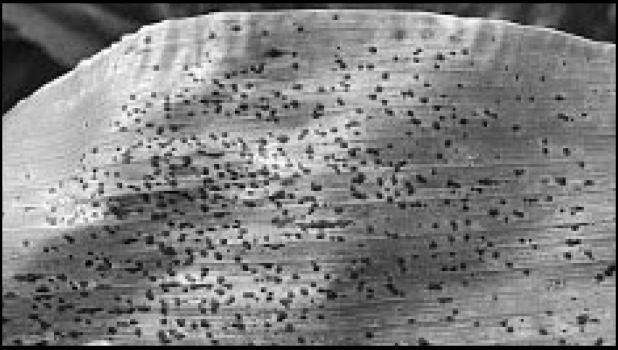
Tar spot is caused by a fungus that produces small, raised black spots on leaves and corn husks that can’t be rubbed off, unlike dirt or insect frass. The spots overwinter in infected residue, then release ascospores that can infect new corn plants. Once infected, a corn plant will show sign and symptoms of disease in 14 to 21 days. After the initial infections, the new tar spots can produce more spores, resulting in secondary infections.
Under moderate temperatures and wet conditions, tar spot can develop rapidly and progress from a few scattered lesions to a fully involved leaf in just two to three weeks. Each season is unique, however, and even under the right conditions, sometimes the disease doesn’t develop as expected.
Darcy Telenko, Extension field crop pathologist from Purdue University, is researching an integrated approach to manage tar spot. One area is whether tolerant hybrids can reduce or eliminate the need for fungicides under high disease pressure.
In a three-year study, the tolerant hybrid significantly reduced disease severity; adding an additional fungicide application did not increase disease control.
However, yields were variable. Until the 2018 epidemic, there was little effort to breed for tar spot resistance. As a result, tolerant hybrids may have less yield potential than top performers. Even when disease is present, a top susceptible hybrid that’s protected by a fungicide may outperform a tolerant one.
Until resistant hybrids are available, applying fungicides for canopy protection is an option, but there are challenges. Most fungicides are active for roughly two to three weeks. If tar spot starts in early July, the corn needs a longer period of protection than if the disease started in September. Once fungicide activity diminishes, tar spot can rapidly redevelop if conditions are favorable.
Fungicide trials were conducted in several states over the past three years. Each year had different weather conditions, which affected both the course of the disease and the optimum timing of fungicide programs.
Although 2020 was moderately wet, tar spot didn’t start until late July. The most effective applications were at first detection and tasseling (VT), but there were no significant yield differences this year.
In 2021, tar spot was detected at the beginning of July. Ample rain early in the season led to early disease development. The best application timing, V8 followed by a second application, resulted in significant yield increases.
Finally, disease pressure was very low in 2022. A single fungicide application at detection had the best control, but there were no significant yield differences for any of the fungicide treatments that year, either.
When researchers combined data from all three years and locations, they learned that fungicides protected yield and provided a positive return in high disease pressure fields. The best timing was at early reproductive stages, resulting in significant yield gains.
In low disease pressure fields, fungicide treatments resulted in negative to negligible positive gains.
“Assess your risk potential,” encourages Telenko. “Do you have tar spot in your fields? If so, the inoculum is present. Scout the lower canopy so you can determine when the disease is starting and if conditions are favorable for development. Then you can decide if you need to protect the upper canopy.”
“Watch for resistant hybrids as they become available,” she adds. In the meantime, fungicides can protect a crop but they will not kill an infection. “Be a good steward and apply fungicides as needed and neccesary to mange tar spot, making sure we use multiple modes of action and rotate products as to minimize the risk of developing fungicide resistance,” Telenko concludes.
